As abuse cases mount in MCC’s global youth programs, Mennonite World Conference Faith & Life Secretary resigns, citing concerns about complicity
by Anicka Fast
On August 10, 2026, I resigned from Mennonite World Conference (MWC). With great sadness, I decided I could no longer remain part of a church institution that refused to appropriately confront mounting evidence of abuse inside its MCC-funded young adult programs.
For three years, I served as Secretary of MWC’s Faith and Life Commission. In many ways, this was my dream job, allowing me to apply my passion for global church relationships to questions of theology, history, and ecumenical relationships within our global communion.
MWC also felt like a place of relative safety in the wake of my own experience of abuse at the hands of MCC leaders. After my husband and I were abusively fired by MCC in 2023, MWC provided me with stability, and colleagues expressed their solidarity with me and other victims of MCC’s abuse in limited, yet significant and embodied ways. MWC leaders also played an important role in urging MCC leaders to the table meet with my husband and me in facilitated conversations beginning in December 2025.
I had hoped to continue this work, but the unfolding abuse crisis made that impossible.
A crisis inside joint MCC-MWC youth programs
As the MAST steering committee continued its work of documenting stories of abuse of MCC workers and partners, they learned about an increasing number of cases of abuse related to MCC’s youth exchange programs. MAST has now documented fourteen credible reports of abuse connected to MCC-funded young adult programs. Nine are related to YAMEN:
Eight cases involving participants in the YAMEN program (a jointly owned MCC-MWC exchange program that brings young adults from outside Canada the US to serve in other international locations for 11 months). Six of these involve sexual abuse, and seven have taken place since 2020. The victims are young women and men from Africa, Asia, and Latin America.
One abusive firing of a Connecting Peoples Coordinator (an MCC staff person who helps to coordinate YAMEN, SALT, and IVEP programs in a particular location) - also since 2020.
Five additional cases have been documented inside other MCC exchange programs (IVEP, SALT, or (the now-discontinued) Youth Discovery Teams)
To understand the scale: MCC reports that more than 270 young people have participated in YAMEN since 2000. MAST has documented nine cases of abuse involving YAMEN since 2020 alone. Even without precise annual participation figures for these years, eight cases within a single program over a six‑year period represent a significant concentration of harm – and these are only the cases we know about.
This is not a statistical blip. This is a grave systemic failure.
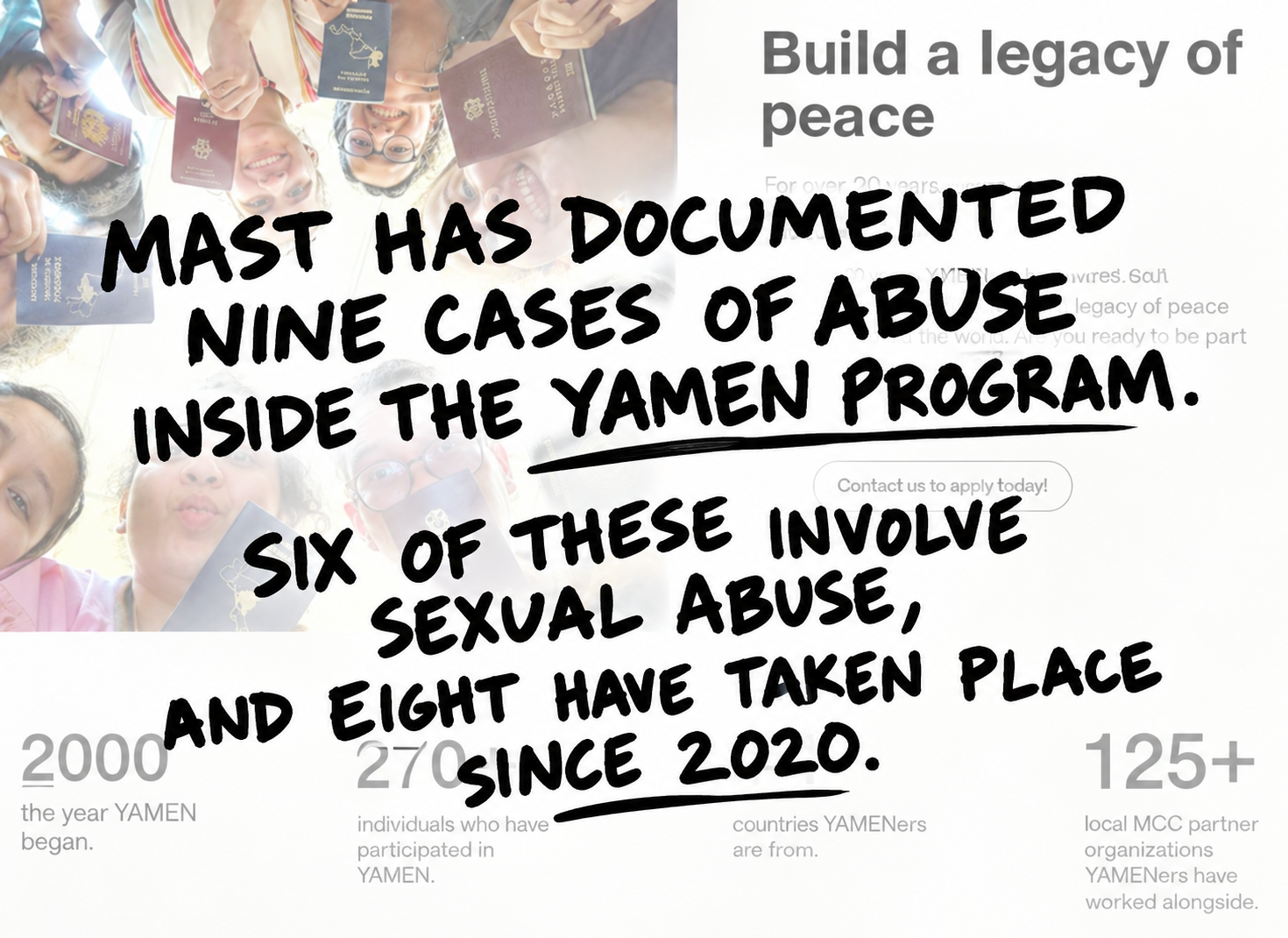
Underlying image is from MCC’s website. I added the overlay with details about abuse.
Reporting to MWC leaders
Because YAMEN is a joint MWC-MCC youth exchange program, I believed that MWC leaders would listen as evidence of YAMEN-related abuse mounted. I hoped they would act immediately: to insist on an external investigation and to press MCC (who administers the program) to end the abuse and make restitution to those harmed.
In my role as an MWC employee, I reported about the YAMEN cases directly to MWC leaders. In February 2026, I arranged a meeting that included members of the MAST steering committee, three survivors of MCC abuse, the MWC general secretary, and another MWC officer. None of the survivors were YAMEN participants themselves, but all three – each of whom had resigned or been fired from MCC – had personal, detailed knowledge of abuse of YAMENers. They reported on at least six of these cases to MWC leaders.
Their stories – which included examples of negligence of health and safety, sexual abuse, and retaliation against those who attempted to prevent further abuse or to expose it – offered clear evidence that the problems are rooted in a system-wide culture that prioritizes image protection over care for vulnerable people.
One summarized the clear pattern they had observed across multiple cases of harm:
“Safety for young people does not matter.”
Another, reporting on how MCC Human Resources staff had intervened to stop them from removing an alleged perpetrator of sexual abuse from a position where he could cause further harm to YAMENers, pointed out that the alleged perpetrator was a prominent member of a Mennonite congregation, while those harmed are “not wealthy,” “have no access to counseling” and have “no other support” to help them cope with the long-term impact of the abuse during their assignment.
MWC leaders expressed concern and asked for time to consider next steps. MAST members urged the need for an external investigation into broader, systemic patterns of abuse in MCC.
After this meeting, no one in MWC ever contacted the MAST steering committee to discuss next steps.
The turning point
While MWC remained silent, MCC escalated the harm.
In March 2026, MCC boards abruptly ended the ongoing facilitated conversation process between MCC board members and my husband and me, followed by a public statement that once again denied any systemic abuse, insisted the conversations had been long enough, and claimed that concerns had already been sufficiently addressed.
The external facilitators reached a different conclusion than MCC. They validated the deep pain we felt about this unceremonious ending to a process that had been designed with the hope of transparency and accountability. Their final report concluded that the process had caused further harm and had re-traumatized us due to MCC boards’ “failure to engage in trauma-informed practices, inattention to power dynamics, and lack of a culture of accountability.”
We hoped that MWC leaders, on reading this professional, external assessment of the failures of these conversations, would be willing to speak out clearly against the broader allegations of abuse. In April, John and I shared the facilitators’ report with the senior MWC leader who had earlier indicated in a conversation that they would be willing to speak out publicly if the conversations broke down. We asked if they would still be willing to speak out. In May, they informed us in an email that the MWC Executive Committee had decided that MCC and other agencies are “not accountable to MWC” (except for the YAMEN program, for which MWC bears “joint responsibility.”) In a subsequent call, they explained that MWC would pursue accountability only for YAMEN-related abuses, despite awareness and a level of agreement that broader issues exist.
This was the moment I knew I had to resign.
Why I cannot stay inside MWC
The logic underlying my decision is simple:
1. Harm is occurring on MWC’s watch. People are getting hurt inside YAMEN. YAMEN is a joint MWC-MCC program, branded and promoted by MWC and administered by MCC. MWC has a direct responsibility to protect these vulnerable young adults. MWC needs to pause YAMEN and insist on external accountability to get to the bottom of the abuse.
2. Because of MWC’s financial dependence on MCC, MWC is complicit if it does not speak out against MCC abuses. MWC can continue to insist that it has no top-down authority over MCC. But this is not an issue of formal authority, but of financial and structural entanglement.
MWC depends on MCC for a significant part of its budget (read my full resignation letter for specifics).
MWC member churches run projects funded by MCC.
Mennonite young adults around the world get to know each other through MCC-funded exchanges.
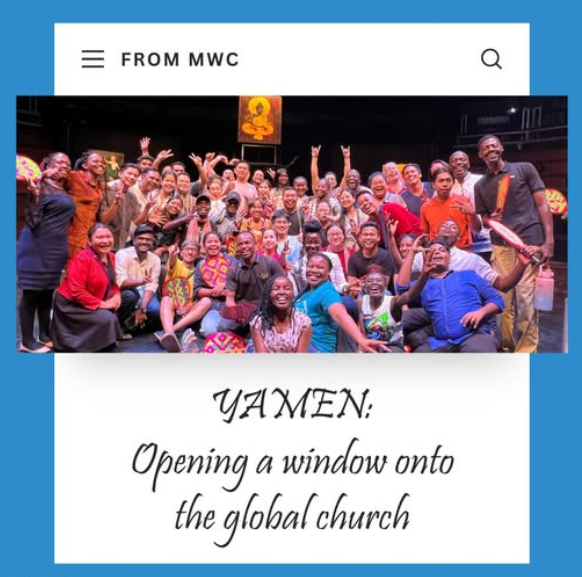
MWC promotion of YAMEN on its Facebook page.
In short, MCC funds the infrastructure of MWC’s global relationships.
This situation creates pressures that make it difficult for MWC to require accountability from MCC.
To avoid complicity, MWC needs to speak up and make its ongoing financial partnership with MCC contingent on an external investigation of all allegations of abuse.
3. The problem is systemic. The patterns of abuse within YAMEN are connected to broader issues within MCC’s leadership culture. Pursuing accountability for YAMEN alone would be like repainting one room in a house while the foundation is crumbling: it will almost certainly not make YAMENers safer and risks entrenching MCC’s ongoing impunity.
My resignation and MWC’s response
I prepared my resignation letter over the course of the summer and sent it to MWC staff, the Executive Committee, and commission members on August 10, 2026.
I later met in person with the General Secretary. The meeting was cordial. He thanked me for my service, prayed for me, and said he would propose some kind of external accountability for the YAMEN cases to the Executive Committee. I have strongly urged him to stay in touch with survivors via MAST when taking any action. MAST has heard nothing further since then.
The facilitators concluded that MCC lacks a “culture of accountability.” Sadly, I have had to conclude that the same applies to MWC. During my three years at MWC, I observed that there is not enough capacity inside the organization to face the need for accountability when abuse comes to light. Staff of an organization may not be directly involved in abuse themselves, but if the organization cannot respond appropriately to reports of abuse, vulnerable people are not safe there.
What can you do?
This is a moment of reckoning for us as a global Anabaptist communion. Structural and cultural change is needed to keep our young people safe and to ensure the integrity of our global witness. Taking clear, public action for accountability is necessary to counter institutional silence and help protect those who are vulnerable.
Here are some things you can do right now:
Call for a global pause in MCC’s youth exchange programs until external accountability is secured.
MWC information is available at https://mwc-cmm.org/en/contact-us/. For MCC, see https://mcc.org/contact.
Meanwhile, pause your own participation in these programs (financial support, promotion, or sending youth from your congregation as participants).
Speak out publicly in your social networks and reach out directly to MCC and MWC leaders. In your communications, stand in solidarity with survivors and call for an external investigation of all allegations.
(For suggested wording, see https://www.mccabusesurvivors.org/get-involved. For examples of letters from others, see https://www.mccabusesurvivors.org/board-letters.)
If your congregation has sent a young adult to participate in an MCC exchange program, proactively check in with them to monitor their safety. Do not assume that they can safely report an abusive experience via MCC’s third-party reporting system. Communicate with them that if something goes wrong, you are there to support them and that if they need to come home early, this is not a failure. Reassure them that their safety and well-being is a priority for you.
Contact the MAST steering committee if you would like to offer other forms of support (stopmccabuse@proton.me) or if you need to report your own experiences of abuse within MCC.
For more information
MAST’s FAQ offers definitions of “abuse” and responds to common questions and objections. See this graphic for a breakdown of the types of abuse that MAST has documented (in the first 93 cases).
MAST’s timeline offers an up-to-date summary of attempts to hold MCC accountable for the abuse of its workers and partners.
You can read my full resignation letter from MWC here.
— Anicka Fast