A ‘Handful’ or a Pattern? Data shows widespread NDA use by MCC
What MCC says about NDAs
MCC has claimed several times that it only rarely uses NDAs. In an August 2024 memo to staff, MCC leaders claimed that “MCC estimates we have used NDAs or non-disparagement clauses less than half a dozen times in the past 12 years” and emphasized the occasional need for NDAs to protect safety in “war zones.” In an opinion piece in Canadian Mennonite, Executive Directors Rick Cober Bauman and Ann Graber Hershberger said, “In the rare occasion when there is potential for a lawsuit, our legal counsel provides us with templated agreements in which both sides agree to not pursue further litigation or disparage the other side.” And most recently in a February 2025 “monograph,” MCC leaders made the following lengthy statement about NDAs:
“MCC seeks to use legal agreements that allow all parties to reach a mutually beneficial resolution to a conflict. In some cases, these agreements require both parties to not file further lawsuits, not disclose confidential information (NDAs), and not engage in disparaging or disrespectful communication when separating. These agreements allow both parties to close a particular work chapter and move on.
MCC rarely uses nondisclosure agreement (NDAs) or non-disparagement clauses. However, there is a time when they are important. Because MCC works in areas of political instability and conflict, what people say online after their service ends can lead to significant risk (and pain) for staff and partners who remain. There are also cases, in conflict zones, where individuals or partners who are named publicly may be at risk for future reprisals by warring groups. In these cases, MCC must have the right to request confidentiality and non-disparagement in separation agreements for the safety of workers and partners.
In consultation with MCC’s legal counsel, it has been estimated that with the hundreds of workers who have served and left MCC over the past decade, NDAs or non-disparagement clauses have only been used a handful of times. Those agreements and clauses were only used after legal counsel had reviewed the situation and made the recommendation.”
In short, MCC claims that it uses NDAs (1) rarely (less than half a dozen times; a “handful” of times), (2) primarily in cases of political instability where the NDA is intended to safeguard the physical safety of colleagues and partners who remain in a war zone; and (3) in ways that are reciprocal (offering protection against further litigation both to the departing worker and to MCC).
What the data show
Based on the 83 cases MAST has documented as of December 2025 (including 43 cases of termination), these claims are all false.
(1) NDAs are not rare.
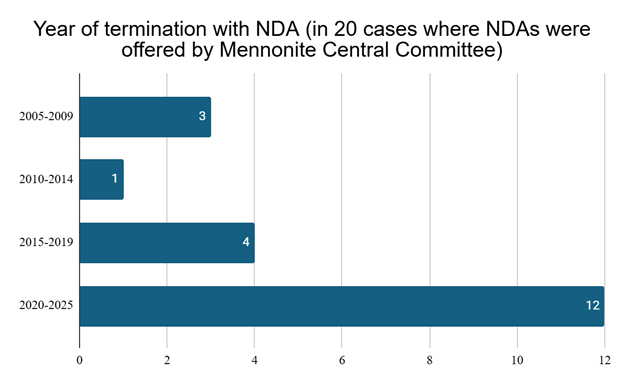
We are aware of 20 cases where NDAs were offered, 16 of which occurred in the last decade. The incidents span many years (2006-2023), indicating a persistent pattern, with use intensifying over time.
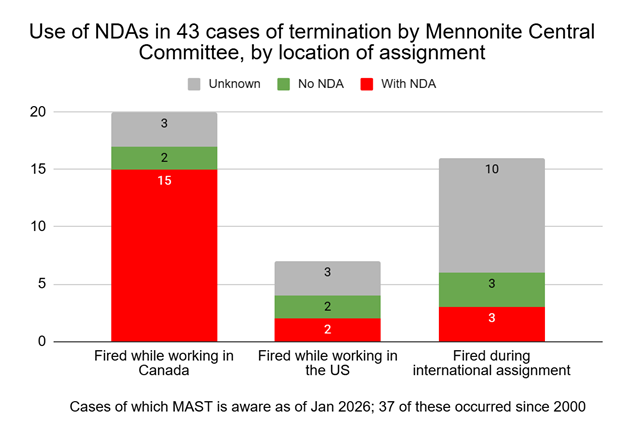
(2) They are not limited to high-risk settings. Only three of the 20 NDA cases involved politically volatile international settings. A higher percentage of NDA use occurred at the termination of workers in Canada (75% of terminations known to MAST involved an NDA) and the US (29% of terminations involved an NDA), compared to international settings (19% of terminations). This undermines MCC’s claim that NDAs are used primarily as a way to protect both workers and MCC in political unstable locations. It seems, rather, that MCC uses NDAs when they feel there is a higher risk that a wrongly dismissed worker will seek recourse.
(3) NDAs are not reciprocal. In the NDAs that we have reviewed, only the worker was subject to non-disclosure and non-disparagement requirements. No such requirement applied to MCC. These were not mutual agreements. No protection from disparagement or legal action was offered to the worker. Review one example here.
NDAs and abuse
When reviewing the 20 NDA cases (with NDAs signed in 17 cases and refused in 3), we see that whistleblowing or prolonged complaints about abuse were often followed by rapid termination, coercive NDA requests, and limited internal redress.
In other words, NDAs are not being used as part of routine, amicable severance packages; they are used at or immediately before termination to limit disclosure about abusive conduct. In every case where substantive details were provided about workplace harm, the offer of an NDA coexists with a report about abuse (bullying, neglect of safety, whistleblower retaliation, false accusations).
As the abuse of workers increases, attempts to silence workers about the abuse are also increasing.

A web of NDA use across MCC
The use of NDAs is not limited to a small group of MCC leaders. Not only are NDAs being used in Canada, US, and international settings, but they are also being used by a large number of MCC leaders.
There are 30 separate MCC staff involved in the 20 NDA cases that MAST knows about. Twelve of these are involved in more than one NDA case. These twelve individuals hold or have held the following roles: HR staff, Communications and Donor Relations staff, HR Director, International Program Director, Provincial Executive Director, National Executive Director, and national Board member. Five of the twelve are still serving with MCC (including the Board member). Six of the twelve (of whom four are still employed by MCC in leadership roles) are also named in other, non-NDA cases of abuse.
What does an NDA termination look like?
Banish from your mind the thought of an amicable separation, or the necessary silencing of a worker who poses a threat to others’ safety. In the cases reported to us, workers describe NDA‑related terminations as abrupt, disorienting, dehumanizing, and often occurring in moments of vulnerability. In the cases we have documented, NDAs are used as “a shield against accountability for abuse, harassment, and discrimination.” Here are some specific examples from different cases that were reported to us:
A worker couple raised concerns about negligence/safety/fraud; they were fired unexpectedly by phone; a planned mediation with their supervisor was cancelled, and the couple was given six days to leave the country with small children. Later, they were offered an NDA.
A worker couple reported workplace-abuse concerns to Executive Directors and Board chair; they were fired without warning or cause while sick and were offered one week to sign an NDA as a condition of receiving support to the end of their term.
A worker couple complained about corruption and about being undermined by supervisors for years; they experienced a crisis with poor care; they were given one hour to decide whether to sign an NDA and then fired.[1]
A worker was terminated through job restructuring after they described as prolonged bullying and devaluation by a supervisor.
A person was walked off the job in a restructuring process that they experienced as callous, with a large severance and NDA
A worker experienced severe emotional abuse by HR; they were pressured by lawyers into signing an NDA and then fired on church premises; there was silence from MCC leadership when the church complained.
A worker experienced decades of supervisor abuse, overwork and constant criticism, and then was forced to resign.
A worker was bullied, then terminated without warning or cause and pressured to sign an NDA.
A worker was fired after standing up to a toxic boss; they were pressured to sign an NDA under threat.
A worker was fired after a false theft accusation at a thrift store after 10 years of service; they had no chance to defend themselves; they were later cleared but with no apology or reinstatement.
A woman of color leader, seen as too outspoken, was suddenly fired with an NDA and a sizable severance; no due process.
A worker was fired for whistleblowing (after protesting other callous firings) with a one-year severance and an NDA.
After a worker was walked off the job with large severance and NDA (as part of a callously-handled downsizing), colleagues were told not to mention their name.
What emerges is unmistakable: MCC’s NDA practices are neither rare, nor safety-focused, nor reciprocal. They are part of a pattern of silencing workers who report abuse.

[1] In the United States, a National Labor Relations Board (NLRB) ruling prohibits offering less than 21 days of time to employees over 40 years old to consider a separation agreement. Link to the OWBPA that explains rights of workers over 40 in separation agreements is here. In Canada, there is no such prohibition.
Tip of the iceberg
The analysis in this blog post rests on the 83 cases of which MAST is aware as of January 2026 (of which 43 cases involve termination). Many more cases likely go unreported, possibly especially where NDAs are involved, as people suffer in silence or out of fear. (One person who signed an NDA told MAST that they had not dared to even write about the events in their personal diary for seven years). As the years go by, people give up hope of ever being heard.
We believe that the stories we know about are just the tip of the iceberg, and yet each one has devastating effects on friends, family, and colleagues left behind in a toxic work environment. Those who participate in or enforce these processes are also morally damaged as they become entangled in a web of secrecy and deceit.
MAST urges donors to consider the substantial amount of money being for pay severance packages that exceed policy requirements, as well as the funds being used to pay legal fees and the staff time involved in managing these situations. Each of the terminations causes life-altering harm to workers and their families that can persist for years or even decades.
External accountability
This analysis reinforces MAST’s conviction that only an external investigation of all allegations can fully address the harm that has been reported. Without strong external accountability, there remains a significant risk that MCC leaders may continue practices that obscure financial misconduct, silence whistleblowers, respond in harmful ways to reports of abuse, and neglect the health and safety of workers.
MAST continues to call on MCC to commit to a full external investigation of all allegations, in which the choice of firm and the mandate of the investigation are approved by the MAST steering committee. This call is supported by more than 1500 petition-signers, by Mennonite leaders such as Desalegn Abebe, Sara Wenger Shenk, Carol Penner, Kim Thiessen and others, by the Central District and Western District boards of MC USA, and by Stirling Avenue Mennonite Church.
We urge MCC supporters to
consider whether they want to continue financially supporting an organization in which such serious concerns remain unaddressed;
join us in asking MCC boards for a full external investigation.